
FINANCIAL POLICIES & COST INFO

Quest House aims to offer affordable lodging to our community, so we operate on a self-selected sliding scale of $175-$125 a night. 

Our sliding scale is built on trust, honesty, and community care. We do not ask for proof  of income and we trust that you will be honest in your assessment of your economic reality and contribute appropriately so that we can continue holding this space for folks who need it.
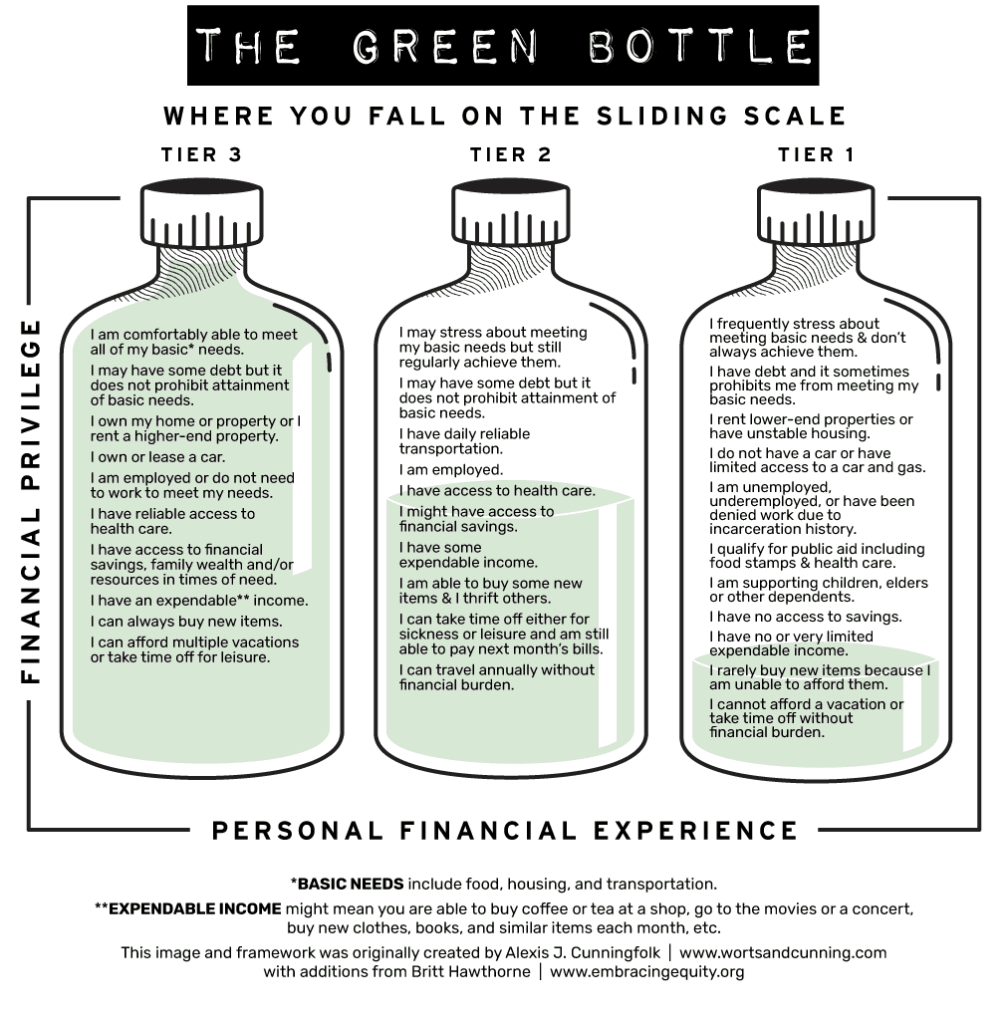
Image description: Graphic with the title, “The Green Bottle: Where You Fall on the Sliding Scale.” Three illustrations of bottles appear side by side, one filled all the way with green liquid, the second filled halfway, and the third filled low. Each bottle has a list of statements. Along the y-axis of the graphic reads, “Financial Privilege” and the x-axis reads, “Personal Financial Experience.” The full bottle lists the following statements: “I am comfortably able to meet all of my basic* needs. I may have some debt but it does not prohibit attainment of basic needs. I own my home or property OR I rent a higher-end property. I own or lease a car. I am employed or do not need to work to meet my needs. I have regular access to health care. I have access to financial savings. I have an expendable** income. I can always buy new items. I can afford an annual vacation or take time off.” The half-filled bottle lists the following statements: “I may stress about meeting my basic needs but still regularly achieve them. I may have some debt but it does not prohibit attainment of basic needs. I own or lease a car. I am employed. I have access to health care. I might have access to financial savings. I have some expendable income. I am able to buy some new items & I thrift others. I can take a vacation annually or every few years without financial burden.” The low-filled bottle lists the following statements: “I frequently stress about meeting basic needs & don’t always achieve them. I have debt and it sometimes prohibits me from meeting my basic needs. I rent lower-end properties or have unstable housing. I do not have a car and/or have limited access to a car but I am not always able to afford gas. I am unemployed or underemployed. I qualify for government assistance including food stamps & health care. I have no access to savings. I have no or very limited expendable income. I rarely buy new items because I am unable to afford them. I cannot afford a vacation or have the ability to take time off without financial burden.” At the very bottom of the graphic are additional definitions. “*Basic Needs include food, housing, and transportation. **Expendable Income might mean you are able to buy coffee or tea at a shop, go to the movies or a concert, buy new clothes, books, and similar items each month, etc. This image and framework was originally created by Alexis J. Cunningfolk | www.wortsandcunning.com with additions from Britt Hawthorne | www.embracingequity.org.”

Quest House Healing Recommended Costs

We want Quest House to be as affordable as possible. We have limited Tier 1 availability, and we trust that only those who need it most will choose this tier. Our Supporter Rate covers the full cost of lodging and supplies.

Tier 3
$ 175
/ Night
  • Supporter Rate
Tier 2
$ 150
/ Night
  • Standard Rate
Tier 1
$ 125
/ Night
  • Subsidized Rate

financial policies

DEPOSIT POLICIES

RESERVATION DEPOSIT

A non-refundable $250 deposit is required to reserve your spot after confirming your booking. Your $250 deposit will go towards your lodging. This deposit allows for 1 emergency booking rescheduling. Any reschedule requests after that will necessitate a new deposit. 

4 WEEKS BEFORE STAY

50% of your balance is due 4 weeks prior to your arrival. 

2 WEEKS BEFORE STAY

The final 50% is due 2 weeks prior to arrival. 

We understand that sometimes there are circumstances out of your control that have an effect on your lodging plans. We aim to be as supportive as possible of your situation, and also have a cancellation policy in place to ensure the sustainability of Quest House.

cancellation policy

  • Any cancellation after paying non-refundable deposit: forfeit $250 deposit
  • Cancellations between 21 – 27 days before check-in: forfeit 20% of lodging total
  • Cancellations between 14 – 20 days before check-in: forfeit 30% of lodging total
  • Cancellations between 7 – 13 days before check-in: forfeit 40% of lodging total
  • Cancellations between 0 – 6 days before check-in: forfeit 50% of lodging total
  • Leaving early after check-in: no credits issued. Any exceptions are at our sole discretion and are based on our ability to fill your space.


Please remember that this is a grassroots, community-run non-profit, and we rely on guest stays to keep this resource running. Please only make a reservation with us if you are truly dedicated to recovering in this space, as it is incredibly hard to fill last-minute cancellation spots. If you book a space you don’t intend to use, that room won’t be available to other folks who need it.

If you anticipate your plans changing, are having second thoughts, struggling with insurance issues, etc.,  please communicate with us.

We may be able to help!

Image description: Graphic with the title, “The Green Bottle: Where You Fall on the Sliding Scale.” Three illustrations of bottles appear side by side, one filled all the way with green liquid, the second filled halfway, and the third filled low. Each bottle has a list of statements. Along the y-axis of the graphic reads, “Financial Privilege” and the x-axis reads, “Personal Financial Experience.” The full bottle lists the following statements: “I am comfortably able to meet all of my basic* needs. I may have some debt but it does not prohibit attainment of basic needs. I own my home or property OR I rent a higher-end property. I own or lease a car. I am employed or do not need to work to meet my needs. I have regular access to health care. I have access to financial savings. I have an expendable** income. I can always buy new items. I can afford an annual vacation or take time off.” The half-filled bottle lists the following statements: “I may stress about meeting my basic needs but still regularly achieve them. I may have some debt but it does not prohibit attainment of basic needs. I own or lease a car. I am employed. I have access to health care. I might have access to financial savings. I have some expendable income. I am able to buy some new items & I thrift others. I can take a vacation annually or every few years without financial burden.” The low-filled bottle lists the following statements: “I frequently stress about meeting basic needs & don’t always achieve them. I have debt and it sometimes prohibits me from meeting my basic needs. I rent lower-end properties or have unstable housing. I do not have a car and/or have limited access to a car but I am not always able to afford gas. I am unemployed or underemployed. I qualify for government assistance including food stamps & health care. I have no access to savings. I have no or very limited expendable income. I rarely buy new items because I am unable to afford them. I cannot afford a vacation or have the ability to take time off without financial burden.” At the very bottom of the graphic are additional definitions. “*Basic Needs include food, housing, and transportation. **Expendable Income might mean you are able to buy coffee or tea at a shop, go to the movies or a concert, buy new clothes, books, and similar items each month, etc. This image and framework was originally created by Alexis J. Cunningfolk | www.wortsandcunning.com with additions from Britt Hawthorne | www.embracingequity.org.”

TIER 3

At the top end of this spectrum are those who can comfortably afford their basic needs without significant worry or strain. These individuals typically have stable incomes, sufficient savings, and manageable expenses. They have the means to cover essentials such as housing, food, healthcare, and transportation without sacrificing other important aspects of life. This level of stability provides a sense of security and allows for planning for the future with confidence.

TIER 2

Moving down the spectrum, there are individuals and families who regularly meet their basic needs but experience occasional stress or anxiety about finances. Despite having steady incomes, they may find themselves living paycheck to paycheck, with little room for unexpected expenses or emergencies. While they can afford essentials most of the time, they may need to make sacrifices or cut back on discretionary spending during lean periods. This level of financial stability requires careful budgeting and may involve occasional trade-offs between immediate wants and long-term financial goals.

TIER 1

At the lower end of the spectrum are those who frequently stress about meeting their basic needs and often struggle to do so. These individuals may have irregular or insufficient incomes, high levels of debt, or significant financial obligations that outpace their resources. As a result, they may regularly face difficult choices between paying bills, buying groceries, or covering other essential expenses.

Sponsor a Night!

If you have access to financial privilege, we encourage you to consider sponsoring a night or more for a community member in need. Mention your interest during your screening call.